Week 7 Blog Post #14

Intro:

My theory of writing, how has it changed? My theory or understanding of writing had grown exponentially as I now have a better grasp on how to write successfully.  I feel that I better understand concepts related to writing such as genre, audience, and rhetorical situation. 

Body:

The idea of learning, knowledge and transfer, how do I apply these to writing now and in the future.  It’s important we don’t only memorize information but fully understand it so that we are able to apply it to other contexts. 

Understanding how something is composed successfully. I have been taught the idea of writing something with an audience in mind but never really put it to practice.  This class I was able to apply the concept of audience and become a better writer with a better understanding of writing.

I had a very remedial idea of the concept of genre.  I now understand the importance of choosing an appropriate genre as well as understand the true meaning of the concept.  Genre isn’t simply a category. 

I will be able to use these skills in the future, both in life and future classes. 

Conclusion:

I will take away much from this course.  The reflections allowed me to consciously take account of knowledge I acquired throughout the course.  My theory of learning has developed and matured over the last 7 weeks, I now feel that I have a decent grasp on my own theory of writing. 
Week 7 Blog Post #13

Learning is the gaining of knowledge, but something even more important than the concept of learning is transfer.  This means that not only have you “learned” something but you are able to apply the knowledge to different contexts.  A reflection is a good way to practice transferring information, applying what was learned during a particular writing assignment to different contexts. 

All knowledge that we have stored in our minds is used in conjunction with knowledge learned every day. We are then, hopefully, able to use this information or knowledge not only in the classroom but apply it to our everyday lives. 

I will use my ability to transfer knowledge in my fourth and final major assignment.  I will attempt to use all of the information learned in the last 7 weeks and apply it to my own definition of writing.  I will “transfer” this knowledge and use it to compose my final reflection. 

Week 6 Blog Post #12

Personally, I both do and do not agree with students in this study.  I believe that some of the knowledge gained from English classes past the first-year courses may not be relevant to every discipline.  I previously would have said that about my own discipline, nursing, but after this seven week course I have been showed otherwise.

Along with my English class I was also taking a community nursing class where we are to create a community education tool for a specific demographic.  This coincides directly with what I was learning in my English course.  In my community nursing course, I was to identify some sort of rhetorical situation, decide on an audience and choose a genre to help me educate the audience.  I think that the English course was both applicable and helpful.

I can see how the knowledge from this course will help me in my future endeavors both academically and in my career. As I decide whether or not to pursue further education after my bachelor’s degree, I will consider that I will have to write frequently in my master’s program. I will need to utilize the tools I gained in this course in any course that I may have to write in in the future, and I believe it will make me a better more effective writer. 

Week 6 Blog Post #11

For each of my three different works, I had to consider different elements that were appropriate for the intended audience or genre.  For example, my infographic won’t include as much information as the entire research paper.  It will however include elements that the research paper will not such as colorful graphics.  The PowerPoint will also include colorful graphics as well but include more information than the infographic. 

It will be important for me to consider the difference in audience as well when deciding what information to include in each piece of work. For my internet article geared toward the general public I will try to appeal to an emotional side where as with my research paper and PowerPoint for hospital administrators I will make more logical appeals. 

Week 5 Blog Post #10

McLuhan Describes medium as, “any extension of ourselves.” When applying this definition to language it would mean that the medium is the way we “extend” our thoughts from ourselves to others.  He also describes medium as the environment or milieu in which the message is extended.   

Modality as described by the Cambridge Dictionary online is, “a speaker’s or writer’s attitude towards the world.”  In reference to grammar, modality in the linguistic tools used within the writing. 

Medium is the method in which content is communicated.  As Yancey says, ‘consider what the best medium and the best delivery for such a communication might be and then create and share those different communication pieces in those different media, to different audiences.” He describes a time when print was the only available medium and now, thanks to technology, we have many options regarding medium. Yancey describes the plethora of options we now have, “Questioning the role of technology in composition programs–shall we teach print, digital, composition, communication, or all of the above?”

Week 5 Blog Post #9

At this point in the course I feel fairly comfortable with the concept of genre.   Compiling all of the knowledge I have gained in the last weeks I would describe genre as applied to writing as a categorization of work by intended action of the writing.  Genre will determine how something is written, what kind of language is used, the tone of the work, and the format of the writing.  An appropriate genre can be chosen to cater for different audiences and purposes. 

For my assignment #2 I did a research paper regarding the practice of floating nurses in hospitals with the intended audience being “higher ups” of the hospital. I wanted to reinforce the idea that it can have a negative impact on both nurses and patients and management or CEO’s should do what they can to minimize the use of floating.  When considering different genres to reformat the information I would like to maybe do an article to inform the public about floating.  I would also like to create a post for social media to gather support against the practice.  I am most excited to create the informatics because I like to use colors and graphics to get my ideas across.

Week 4 Blog Post #8

After reading Swales’ piece I realized that a discourse community that I am part of would be my work places Facebook group. All of the employees are part of this closed group to communicate things regarding work. I can easily apply all six of the characteristics of discourse community to this group.  The first characteristic is that the community has an agreed upon set of goals.  In this case our group has the goal to create a connected work environment with good communication that provides exceptional care to patients. The second characteristic is that the community utilized mechanisms of communication, in this case we communicate via facebook posts, messenger and private text messages. This group primarily serves to provide information to its participants, meaning that it applies to the third concept of providing information and feedback.  An example of this could be a facebook post proposing a new holiday rotation that requires feedback from its members.

This discourse community mainly utilizes the genre of facebook posts.  Most posts are geared toward all of the community members and communicate using a casual tone.  The fifth characteristic is that the group communicates using specific lexis. For this group where we are all nurses, we use certain terms and language to describe what we are talking about.  The final characteristic is that there are members at all different experience levels.  The members of the group changes regularly as new employees are added and others move on to other jobs. 

When thinking of a discourse group I participated in but didn’t necessarily assimilated to, I think back to high school.  As someone not really gifted in the athletic department, joining a sports team was difficult for me.  I joined lacrosse when I was a junior in high school, all of the girls knew each other and got along they all understood the rules of the game. As someone new to the sport and sports in general I was sort of an outcast, struggling to understand how the game was played.  After three or four weeks I decided lacrosse was not for me and that I would no longer be a member of that discourse group. 

Week 3 Blog Post #7

Grant-Davie describes purpose as a critical component to consider when writing or reading.  One must first identify a purpose before creating a successful piece of writing.  My idea of research has shifted a bit, prior to this week’s reading I think I would have considered a research paper just a collaboration of information.  Now I better understand that we are to make new connection through the research we conduct.    

As Grant-Davie says, all of these terms (rhetorical situation, genre, audience, reflection) are interlaced and as we continue to read and better understand the terms more connections between them become apparent.  Purpose is another staple to successful writing, along with the audience and genre we must also identify our purpose for writing. 

I think the biggest take away I gained from reading Greene’s work is that research isn’t only about gathering information.  Research needs to be a process where information and new knowledge is created.  We are to make new conclusions and ask new questions when conducting research.

I have already created a poll on Facebook and had about 500 participants in answering the poll questions.  I think that this is a fairly good method of gathering information as I received answers from people from many different demographics and backgrounds.  I also intend on interviewing one of my coworkers to further discuss the research question, though this is limiting as it is just one person’s opinion about their personal experience.

Week 3 Blog Post #6

I would describe knowledge as all of the information we collect over our lives.  This can be things deliberately learned in the classroom or from life experiences that we can take something away from.  Learning is the process in which we collect this knowledge. 

“Knowledge is built on experiment, induction, replication, and falsifiability” (Hyland 194). Hyland describes knowledge as a collaboration of everything we have learned and experienced.  Information is a set of facts that can be used to build on knowledge. 

Collaboration is crucial in the knowledge making process.  Without collaboration new innovations and ideas would take infinitely longer.  Everything we know today is built upon someone else’s knowledge and discoveries.  With collaboration of the minds we are able to use different people’s knowledge and experiences to build on one another and make greater progress. 

I appreciate Johnsons’ view on the creation of ideas and innovation.  A lot of the times the conception of an idea is depicted as a single instance where someone has a “lightbulb” moment.  In fact, most of the time this is not the case, an idea is s process made up of new connection being made in our brains.  The idea is a collection of everything we’ve learned during the knowledge making process, not just a random moment where everything becomes clear. 

What I took away from the reading and the TED talk is that knowledge is personal.  Several people can read the same information and each have a different understanding or different knowledge on the subject.  Knowledge is all about using everything we know together to make connections of information. 

Week 2 Blog Post #5

Yancey defines reflection as a type of behavior indicative of “growth of consciousness.” Yancey states “… reflection as a means of going beyond the text to include a sense of the ongoing conversations that texts enter into” (5). According to Yancey a reflection allows us to learn from and improve our writing.

The source that I found online describes reflection and reflective writing as a mental process and a thought process that allows you to interpret “…what is going on between learning and thinking”

Yancey uses the ideas of other scholar’s such as Schon and Bitzer as building blocks to create her own unique definition of reflection.   

A reflection is in and of itself a rhetorical situation.  The exigence being to better understand what does and does not work in the writing.  Genre and audience are both considered in the Reflection-in-action stage of the reflection.  Yancey says, “In the composing of any text, the writer attempts to create novel responses based on new ways of seeing the situation, the purpose, the audience, the genre and hence the material” (14). Reflection-in-action should include thought and revision of all of these components. 

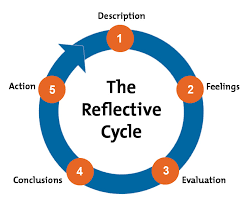
Yancey as well as the article I found online focuses on reflection being a process of thought and revision.  Reflection is a point where we can ask ourselves about the effectiveness of our writing and hone in on certain points that could benefit from revision.   

I chose the above image because I think the it accurately depicts reflection as an active process.

Source: https://grammar.yourdictionary.com/for-students-and-parents/what-is-reflective-writing.html#