
Yancey defines reflection as a type of behavior indicative of “growth of consciousness.” Yancey states “… reflection as a means of going beyond the text to include a sense of the ongoing conversations that texts enter into” (5). According to Yancey a reflection allows us to learn from and improve our writing.
The source that I found online describes reflection and reflective writing as a mental process and a thought process that allows you to interpret “…what is going on between learning and thinking”
Yancey uses the ideas of other scholar’s such as Schon and Bitzer as building blocks to create her own unique definition of reflection.
A reflection is in and of itself a rhetorical situation. The exigence being to better understand what does and does not work in the writing. Genre and audience are both considered in the Reflection-in-action stage of the reflection. Yancey says, “In the composing of any text, the writer attempts to create novel responses based on new ways of seeing the situation, the purpose, the audience, the genre and hence the material” (14). Reflection-in-action should include thought and revision of all of these components.
Yancey as well as the article I found online focuses on reflection being a process of thought and revision. Reflection is a point where we can ask ourselves about the effectiveness of our writing and hone in on certain points that could benefit from revision.
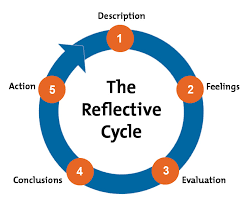
I chose the above image because I think the it accurately depicts reflection as an active process.
Source: https://grammar.yourdictionary.com/for-students-and-parents/what-is-reflective-writing.html#
 English Composition
I think the visual you provided is a great representation of the reflection and revision cycle. The definition I found on the page that I read is similar to yours, except it emphasized reflecting as you write. I think this is also an important part of the process to consider.
LikeLike
I like the example you used and helps have a better understanding!
LikeLike